
Admit I
Rayzm 6-inch tongue drum, 11 notes
Players who want size, key and a songbook
| Notes | 11, in D |
|---|---|
| Size | 15.2 cm across, 7.5 cm high |
| Weight | 0.9 kg |
| In the box | Mallets, bag, picks, songbook |
4.5/5 on Amazon from 664 ratings
See it on Amazon

Tuned steel, no skin
A steel tongue drum looks like a small flying saucer and plays like a xylophone. We compared five, and sorted the garden rain drums from the rest.
By Rhys Entwistle, updated 4 November 2026
Act I
A steel tongue drum is a hollow steel disc with slots cut into the top, and each slot forms a tongue that sounds a different note when struck. It looks like a small flying saucer and plays like a xylophone that has swallowed a bell.
In British listings the same instrument is also sold as a garden rain drum, an outdoor chime or, wrongly, a handpan. The words change and the steel does not, so it pays to read what is really described.
A rain drum for outside is the same instrument with a finish the seller claims will resist weather. It does not make rain, and it is not a reason to leave an instrument out in a storm.
Act II
Our order favours the drum with a stated size, a stated key and a full set of extras. All five are played with mallets or fingers, and all five lay out their notes to be forgiving.
Admit I
Rayzm 6-inch tongue drum, 11 notes
Players who want size, key and a songbook
| Notes | 11, in D |
|---|---|
| Size | 15.2 cm across, 7.5 cm high |
| Weight | 0.9 kg |
| In the box | Mallets, bag, picks, songbook |
4.5/5 on Amazon from 664 ratings
See it on Amazon
Admit II
VEVOR 12-inch tongue drum, 13 notes
Players wanting a larger body in C major
| Notes | 13, C major |
|---|---|
| Size | About 30 cm across |
| Weight | About 2.5 kg |
| In the box | Two mallets, carry bag |
4.4/5 on Amazon from 67 ratings
See it on Amazon
Admit III
LEKATO 6-inch tongue drum, D major
Beginners wanting picks and a tutorial book
| Notes | 11, D major |
|---|---|
| Size | About 15 cm across |
| Material | Painted steel alloy |
| In the box | Mallets, four picks, book, bag |
4.5/5 on Amazon from 576 ratings
See it on Amazon
Admit IV
RUNZI 6-inch tongue drum, green
Small hands, with age guidance to check
| Notes | 8, C major |
|---|---|
| Scale | Pentatonic, claimed |
| Weight | About 700 g |
| In the box | Two mallets, bag, sticker |
4.7/5 on Amazon from 27 ratings
See it on Amazon
Admit V
REGIS 6-inch rain drum, malachite
Garden shelves with a dry place for storage
| Notes | 8 tones |
|---|---|
| Size | About 15 cm across |
| Weight | About 700 g |
| Colour | Malachite |
4.4/5 on Amazon from 3,000 ratings
See it on AmazonRayzm gives its numbers plainly: 6 inches (15.24 cm) across, 7.5 cm high, 0.9 kg and 11 notes in D. It claims 2 mm carbon steel under a brown waterproof lacquer, with tuning accurate to within 10 cents.
Mallets, a bag, note stickers, finger picks and a songbook are in the box. Rayzm itself recommends mallets over fingers, which is honest advice, since striking by hand needs a technique most of us have not practised.
VEVOR sells a 12-inch (30 cm) drum with 13 notes in C major, in carbon steel, with two mallets and a carry bag. At a claimed 2.5 kg it is the heaviest of the five and the one that wants a lap or a stand.
The listing also calls it a steel drum for the garden. Treat that as a claim about the finish rather than an invitation to leave it out overnight.
LEKATO offers 6 inches and 11 notes in D major, in painted steel alloy. The box holds a pair of mallets, four finger picks, a tutorial book, two tone stickers and a storage bag.
RUNZI claims 8 notes in C major drawn from a pentatonic scale, in a 6-inch body in green, with two mallets, a bag and a tone sticker. The listing is aimed at children and preschool activities, so check its age guidance.
REGIS describes a 6-inch drum with 8 tones, sold as a rain drum for outside, in a malachite colour and about 700 g. Mallets are included, and the colour is the nearest thing to a personality in the group.
| Drum | In the box |
|---|---|
| Rayzm | Mallets, bag, note stickers, finger picks, songbook |
| VEVOR | Two mallets, carry bag |
| LEKATO | Mallets, four finger picks, tutorial book, two tone stickers, storage bag |
| RUNZI | Two mallets, bag, tone sticker |
| REGIS | Drum mallets |
Act III
The key and the number of notes are the two figures that matter on a tongue drum. Everything else is accessories and colour.
| The act | Best for | Rating | Where |
|---|---|---|---|
| Rayzm 6-inch tongue drum, 11 notes | Players who want size, key and a songbook | 4.5/5 | Amazon |
| VEVOR 12-inch tongue drum, 13 notes | Players wanting a larger body in C major | 4.4/5 | Amazon |
| LEKATO 6-inch tongue drum, D major | Beginners wanting picks and a tutorial book | 4.5/5 | Amazon |
| RUNZI 6-inch tongue drum, green | Small hands, with age guidance to check | 4.7/5 | Amazon |
| REGIS 6-inch rain drum, malachite | Garden shelves with a dry place for storage | 4.4/5 | Amazon |
The key decides what you can play with. A drum in C major sits comfortably beside a piano or a recorder, and one in D suits a guitar or a ukulele. Played alone, either key works equally well.
Eight notes give you one octave and a scale you can learn in an afternoon. Eleven notes add a few below and above, and the 13-note VEVOR spreads over a larger body.
Many are tuned to a pentatonic scale, the five-note pattern that folk tunes lean on. Any two notes sound acceptable together, which is why a wrong tongue is seldom a wrong note.
Act IV
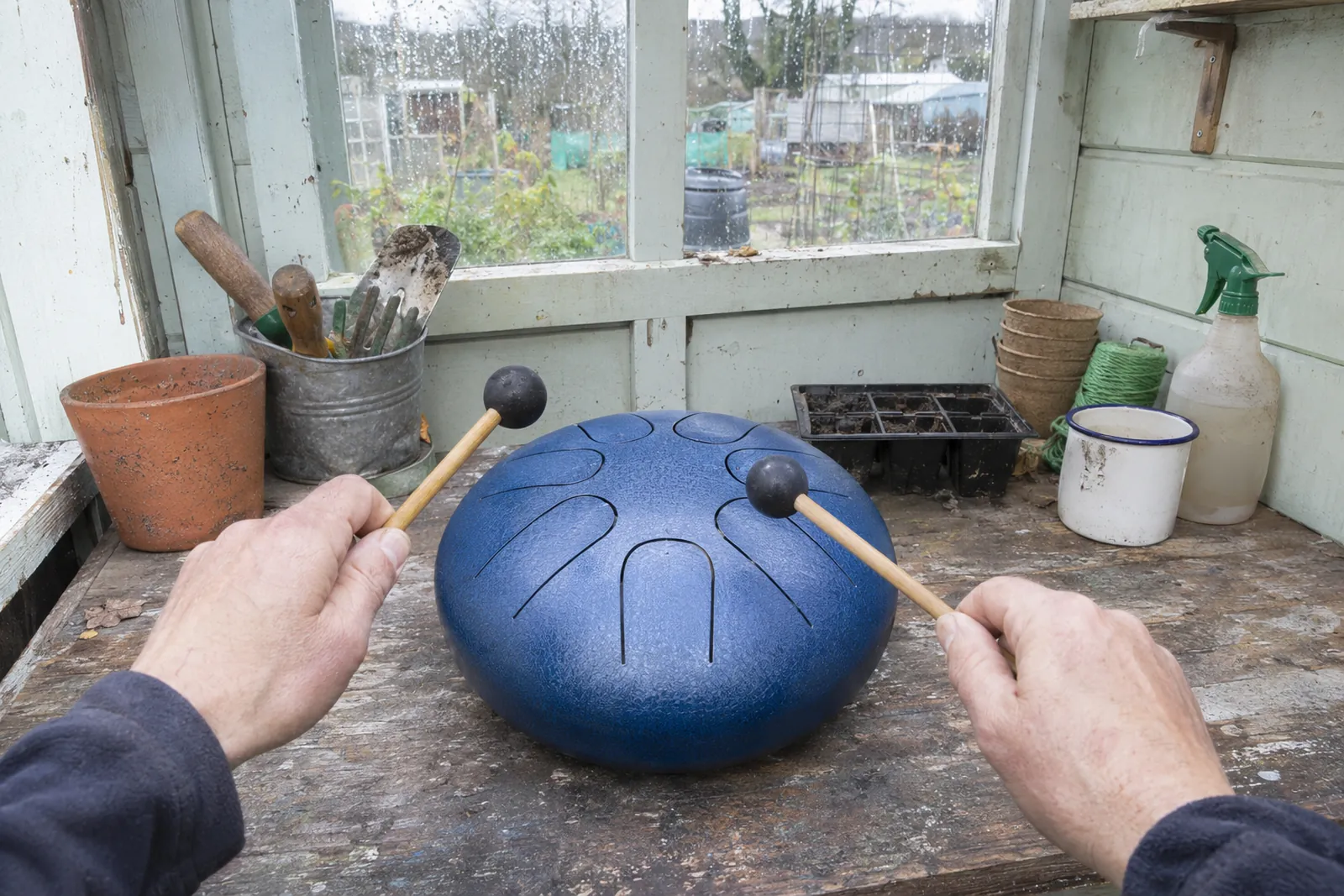
The body is a closed steel shell, cut on top with slots that leave tongues of different lengths. Strike a tongue and it vibrates, the shell resonates and the sound leaves through a hole.
The shell is a resonator, much like the body of a guitar. Without somewhere for the air to move, the notes would die quickly. With it, each tongue rings for a surprisingly long time.
Act V
You can play a tongue drum three ways, and each one suits a different mood. Mallets are the sensible start, because they are forgiving about where and how hard you strike.
Strike the tongue rather than the gap between tongues, and let the mallet bounce away at once. A short, light touch lets the note ring, while a firm press deadens it.
Fingers give a softer note but ask for more technique, as Rayzm points out. Finger picks, included with Rayzm and LEKATO, give a clearer attack and spare the fingertips.
Rest it on your lap, with the bag between the steel and your legs, or place it on a stand if you have one. Do not clamp it tightly, since a drum held rigidly will sound dull.
Act VI
Size changes the weight, the number of notes and the depth of the sound. Most are 6 inches or 12 inches, and our five sit at the two ends.
| Size | Across | Notes | From our five |
|---|---|---|---|
| Small | 6 inches, 15 cm | 8 to 11 | Rayzm, LEKATO, RUNZI, REGIS |
| Large | 12 inches, 30 cm | 13 | VEVOR |
The 6-inch drum is light, easy to carry and quick to learn on. Rayzm gives a weight of 0.9 kg, which is lighter than a bag of sugar and a good deal louder than one.
The 12-inch VEVOR gives more notes and a lower voice. It is heavy enough that most players will want it on a stand or a lap cushion.
Act VII
The idea of a tongue is older than the steel. Wooden slit drums, with tongues cut into a hollow log, have long been made in several parts of the world, and the steel tongue drum is a modern cousin.
| Idea | Where | What it added |
|---|---|---|
| Wooden slit drum | Several parts of the world, over many centuries | Tongues cut into a hollow body |
| Hang | Bern, 2000, by PANArt | Tuned steel notes played by hand |
| Steel drum with tongues | Made by many workshops today | A simpler, flatter build with slots for notes |
The name tank drum is usually explained by the steel gas tanks that early makers cut up. The Swiss Hang, made by PANArt in 2000, pushed the idea of tuned steel into the public eye, and the handpan followed it. It is a simpler, flatter relative.
Act VIII
The two get confused constantly, partly because sellers confuse them first. The slotted disc is the simpler of the two, and the table says why.
| Feature | Steel slotted drum | Handpan |
|---|---|---|
| Shape | A single shell with a slotted top | Two shaped steel shells joined at the rim |
| Notes | Tongues cut into the top | Notes hammered into the surface |
| Played with | Mallets, fingers or picks | Hands, usually without mallets |
| Sold as | Tank drum, rain drum and, loosely, handpan | Handpan, and loosely hang drum |
If a listing calls a small slotted disc a handpan, it is a tongue drum with a different label. The kalimba is closer than either to a fixed-note instrument you can pocket.
Act IX
The sound is a rounded, bell-like tone with a long ring, and playing quickly lets the notes overlap into a wash. That is a feature at slow tempos and a hazard at fast ones.
Rest a fingertip lightly on a tongue and the note stops at once. It is the only brake the instrument has, and a good player uses it more often than a beginner expects.
Act X
Two drums in the same key play together without a rehearsal, which is rare in music and a good argument for buying a pair. The notes of one cannot clash with the notes of the other.
A drum in C and a drum in D do not agree, and the result sounds like a disagreement. If you own two, check the key printed on each before the first duet.
Act XI
Listings for these instruments are enthusiastic and occasionally generous. We read each claim as the seller’s, and treated it as information about the maker rather than a measurement.
| The listing says | How we read it |
|---|---|
| Waterproof lacquer | A statement about the finish, not permission to leave the drum in the rain |
| Tuned to within 10 cents | A seller figure, and ten cents is a tenth of a semitone |
| Rain drum for outside | The same instrument with a garden label |
| Handpan in the title | Check the picture, because it may be a slotted disc |
| Pentatonic scale | Five notes per octave, chosen so they agree with each other |
The photograph shows whether the top has slots or shaped dimples. Slots mean a tongue drum, and dimples hammered into a domed shell mean something else.
Act XII
A tongue drum needs no lessons, but a little order helps. This plan takes about half an hour and ends with something you can play for visitors.
Act XIII
Steel is tough but not stainless, and every tongue drum depends on its finish. A few habits keep it sounding clean.
The rubber on a mallet tip perishes before the steel does. Keep a spare pair in the bag, and replace a tip that has gone hard or split, since a damaged tip chips the finish and gives a harsher note.
Act XIV
Giving one is easier than giving most instruments, because the playing is forgiving. The listings differ in size and in what is in the box.
Act XV
We would put the Rayzm first, because a tongue drum should say plainly what it is and this one does. The VEVOR is the pick for a bigger sound and the RUNZI for small hands.
The rest of the bill is full of louder ideas and quieter ones, but few as honest as a steel disc with a hole in it.
Encore
Mainly for playing tunes. The notes are tuned to a scale, so anyone can tap out a melody or a simple accompaniment. Some listings also sell the same object as a garden chime, which is a matter of where you hang it.
The playing is easy at any age, but the age guidance belongs to the listing and the maker. Check it, especially for small mallets and finger picks, and supervise young children as the instructions suggest.
No. The notes are chosen to sound agreeable together, so a wrong tongue is rarely a wrong note. The challenge is a light, even strike and a steady rhythm, which comes with an evening of practice.
No. It has slots cut into a steel top, while a handpan has two shaped steel shells and notes hammered into the surface. Some listings use the word handpan loosely, so read the description.
Only if the maker says so. Several listings call their drum a rain drum for outside and claim a weather-resistant finish, but steel rusts, so a dry shelter and a bag are the safer plan.
Pick the key that matches whatever you will play with: a ukulele, a keyboard or a friend with a kalimba. If you will play alone, choose by ear and by the number of notes you want.
Not by a beginner. The tongues are cut and tuned at the factory, and filing a tongue changes it for good. If a note has gone wrong, go back to the maker.