
Suzuki Omnichord OM-108
Chord-minded players who want a strum and rhythms
| Chords | 38 buttons, 108 claimed |
|---|---|
| Strumplate | Four octaves, touch-sensitive |
| Rhythms | 10 styles |
| Size | 45.7 × 25 × 5.2 cm, 1.2 kg |
4.3/5 on Amazon from 26 ratings
See it on Amazon

Launched 1981, reissued 2024
The Omnichord OM-108 is the 2024 reissue of Suzuki’s 1981 instrument, which pairs chord buttons with a touch plate you strum. Our score is 8.3, and stock on Amazon is low, so check availability early.
By Rhys Entwistle, updated 4 November 2026
Suzuki Omnichord OM-108
Chord-minded players who want a strum and rhythms
| Chords | 38 buttons, 108 claimed |
|---|---|
| Strumplate | Four octaves, touch-sensitive |
| Rhythms | 10 styles |
| Size | 45.7 × 25 × 5.2 cm, 1.2 kg |
4.3/5 on Amazon from 26 ratings
See it on AmazonAn independent site with no connection to Suzuki, Meloclub or Dubreq: not official, not an authorised dealer. Omnichord and Stylophone are trade marks of their owners, named here only to identify the real products.
Act I
8.3out of 10
| Sheer pleasure | 9.1 |
|---|---|
| Sounds | 8.4 |
| Learning curve | 8.7 |
| Connections | 7.2 |
| Availability | 6.3 |
The Omnichord OM-108 has few direct rivals, which is partly why it stays interesting. The nearest in spirit are an acoustic autoharp and a pocket Stylophone, and neither does quite what the Suzuki does.
| The act | Best for | Rating | Where |
|---|---|---|---|
| Suzuki Omnichord OM-108 | Chord-minded players who want a strum and rhythms | 4.3/5 | Amazon |
 Oscar Schmidt OS21C 21 chord autoharp | Folk players who want 21 chords and a maple body | new | Amazon |
 Stylophone Original Pocket Synthesizer | Anyone wanting the classic stylus synth in a pocket | 4.6/5 | Amazon |
The autoharp also puts chords under a bar, but it does so with wooden bars and real strings and no electronics at all. It asks for tuning where the Omnichord asks for batteries, and it will never play a bossa nova on request.
The Stylophone is a stylus on a metal keyboard that plays one note at a time. It is the better pocket instrument, whereas the Omnichord is the better accompanist, with chords, rhythms and strumming all in one case.
If you only want to sample the principle, our online chord strip is free, and it will not mind if you leave early.
Act II
We read the specification line by line and set the OM-108 beside the listings of its nearest rivals. The Omnichord was judged on paper: what it offers, what it leaves out and what a buyer is likely to notice first.
Scores are our opinion, out of ten, drawn from those listings and weighted by what a buyer notices first. The pleasure of playing counts most, and the number of sockets counts least.
Act III
These are the public figures for the OM-108, and anything the maker claims is marked as claimed.
| Feature | Detail |
|---|---|
| Original launch | Suzuki, 1981 |
| This model | OM-108, the 2024 reissue |
| Chord buttons | 38 |
| Chords | 108, claimed |
| Strumplate | Four-octave, touch-sensitive |
| Strumplate tones | 10, claimed |
| Rhythm styles | 10 |
| Melody keyboard | 20 keys with octave shift |
| Sound circuits | omni1 and omni2 from the analogue models, alongside digital sounds |
| Outputs | Mono line out, stereo mini-jack headphone out, MIDI OUT |
| Power | Batteries, or an optional mains adapter sold separately |
| Size and weight | 45.7 × 25 × 5.2 cm, 1.2 kg |
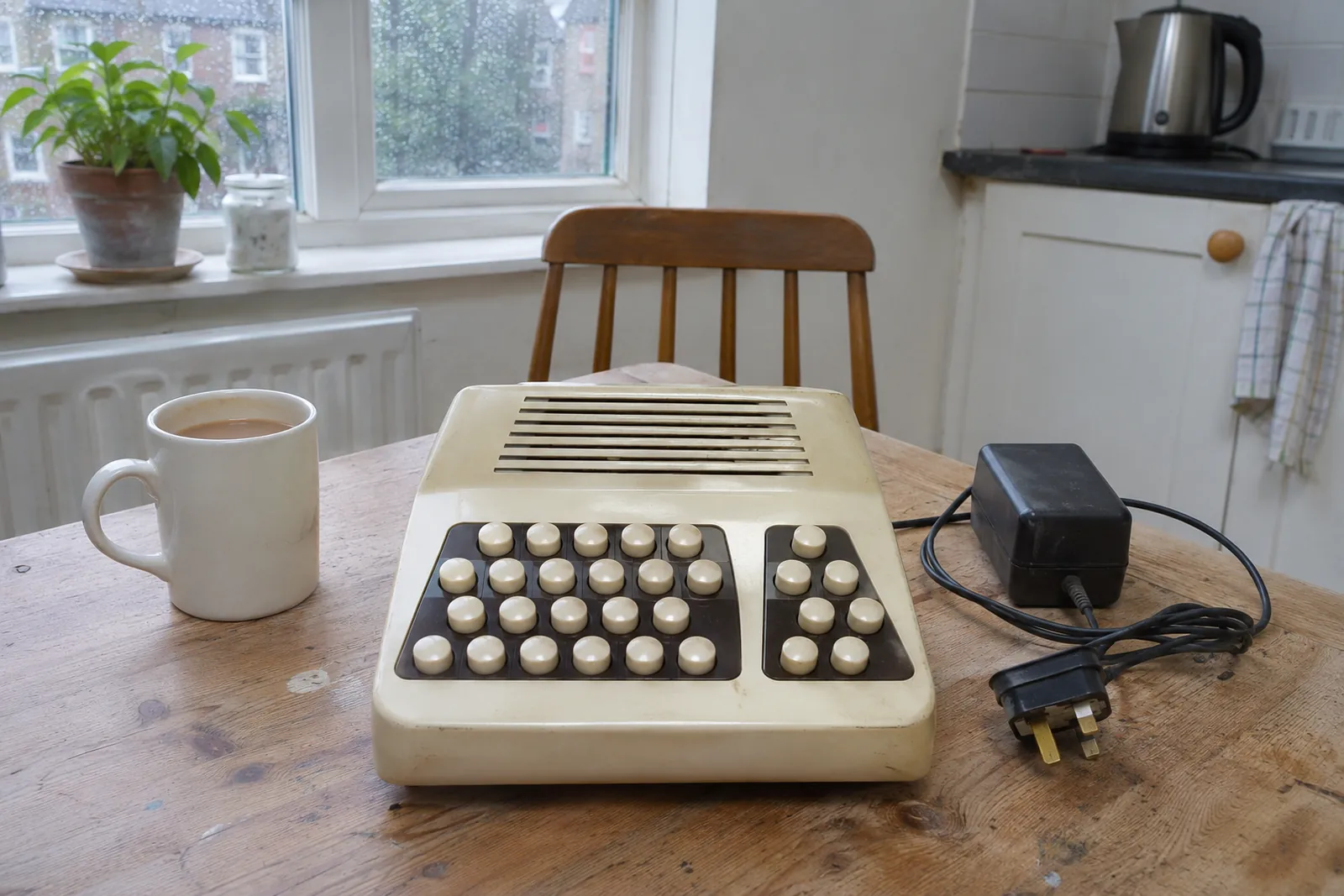
Suzuki launched the Omnichord in 1981 as an electronic instrument with chord buttons on one side and a touch plate on the other. The OM-108 is the 2024 reissue, and it keeps the layout and the omni1 and omni2 circuits of the analogue models.
The reissue pairs them with digital sounds, a melody keyboard and a MIDI out, so the Omnichord of 1981 now talks to a modern studio, if only in one direction.
Act IV
Everything about the Omnichord comes down to four things working together. The strumplate, the chord buttons, the rhythms and the sounds each carry part of the load, and the pleasure lies in how little each has to do alone.
The strumplate is a four-octave touch-sensitive plate that you strum with a fingertip. The notes that sound belong to the chord you hold, which is why the Omnichord forgives a nervous hand better than a guitar does.
Ten strumplate tones are claimed, from which you choose the colour of the strum. The plate is touch-sensitive, so a light stroke and a firm one should answer differently, which is what keeps it from being a toy.
The 38 chord buttons are the other half of the instrument, and the listing claims 108 chords from them. Learning where the chords live is the real work of the first week, after which the Omnichord gets out of the way.
Chord order is a matter of taste, but a gentle one helps. Start with the major chords of a single key, add the minors next, and only then wander into the more exotic buttons.
Once the chords feel familiar, practise changing chord against a steady rhythm, because timing is what separates a strummer from a player. Learn two or three songs end to end, then try the octave shift on the melody keys.
Ten rhythm styles give the Omnichord its own drummer, who never rushes and never has opinions:
Waltz and Bossa Nova are the two that raise eyebrows, and they are the reason to keep the rhythm section on for a first song.
The OM-108 carries the omni1 and omni2 circuits from the analogue models alongside digital sounds, so the old Omnichord character is there next to newer voices. A 20-key melody keyboard with octave shift sits beside the chord buttons for playing a tune over the chords.
The OM-108 has a mono line out, a stereo mini-jack headphone out and a MIDI OUT, and runs on batteries or an optional mains adapter. That is enough to play at home or plug into an amplifier, and it explains the middling score for connections.

Admit I
Suzuki Omnichord gig bag OGB-108
OM-108 owners who carry their instrument about
| Fits | OM-108 only |
|---|---|
| Material | Polyester |
| Size | 49 × 26.5 × 10 cm |
| Strap | 74 to 135 cm |
4.6/5 on Amazon from 11 ratings
See it on Amazon
Admit II
Suzuki power supply for OM-108
OM-108 players who prefer mains to batteries
| Plug | 3-pin |
|---|---|
| Input | 100 to 240 V AC |
| Safety | Double-insulated |
| Standards | CE, RoHS, WEEE |
| Accessory | What the listing says |
|---|---|
| Gig bag OGB-108 | Fits the OM-108 only, holds the adaptor and cable, polyester, 49 × 26.5 × 10 cm, 540 g, strap 74 to 135 cm |
| Power supply | Suzuki-approved, 3-pin, 100 to 240 V AC input, double-insulated, CE, RoHS and WEEE compliant |
Older Omnichord models do not fit the bag, so it is an OM-108 purchase only.
A MIDI OUT lets a computer or a synthesiser listen to what you play. The OM-108 offers that and not a great deal more in the way of studio connections, so anyone with ambitious plans should read the connections score with care.
Act V
Few instruments get a second look from guests as quickly as an Omnichord does. Its shape, its chord buttons and its strumplate invite questions, and you will be asked to demonstrate it at the least convenient moment.
The Omnichord is also not for the impatient buyer, because of the stock position described next.
The Omnichord gives a songwriter chords, a rhythm and a strumming sound in one case, and the MIDI OUT lets a recording setup capture what you play. It is a sketchpad with a character of its own.
Act VI
Stock of the OM-108 is low on Amazon, and so is stock of its gig bag. Check availability before you commit, and look twice at third-party sellers.
The power supply was listed as in stock at the time of writing, so the one accessory you are certain to need is the easiest to find. Low stock is also why this Omnichord scored lowest on availability and nowhere near lowest on enjoyment.
Act VII
A short list of honest questions saves a disappointed afternoon, because the OM-108 suits a particular sort of player.
Act VIII
The Omnichord OM-108 earns 8.3 out of ten. It scores highest on sheer pleasure, with strong marks for sounds and a gentle learning curve, and it loses points for its modest connections and its stock.
Waiting for stock to improve loses nothing. In the meantime, our free online chord strip shows whether chord-first playing suits you.
If you like the idea of chords under one hand and a strum under the other, this is the best-looking way to find out. Buy it if you can find one, and bring a friend who is willing to play the bossa nova.
Encore
Yes. Suzuki launched the original in 1981 and the OM-108 is the 2024 reissue. Stock on Amazon is low, so check availability before planning your weekend around it.
You hold a chord button with one hand and sweep a finger across the touch-sensitive strumplate with the other. The strumplate plays the notes of the chord you have chosen, so even a clumsy sweep stays in key.
It shares the chord-first idea, but the Omnichord is electronic and the autoharp is acoustic, with strings and wooden bars. Our autoharp page covers the acoustic one.
No. The chord buttons carry the chords, and you can learn songs by ear or from chord names. The 20-key melody keyboard is there for anyone who does want to play a tune.
It is easy to start and gently demanding to do well. The first chord sounds like music within a minute, and learning to change chords on time takes longer, which is why we scored the learning curve generously.
We cannot see the stockroom, but the OM-108 is low on stock on Amazon, along with its gig bag. Check who is selling before you order.
You can try the idea, not the instrument. Our own chord strip plays in the browser, has no rhythms or MIDI, and is not an Omnichord, but it shows whether chord-first playing suits you.
It runs on batteries, or on an optional mains adapter that is sold separately. The Suzuki-approved 3-pin power supply in our list takes 100 to 240 V AC.