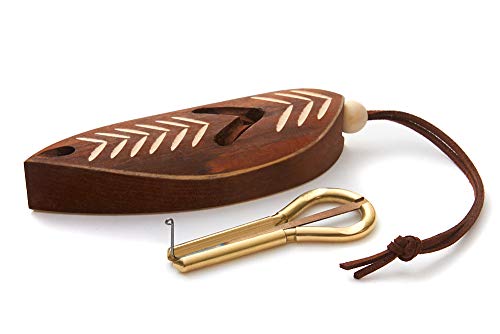
Admit I
MUARO Potkin jaw harp, wooden case
Players who want a named Altai maker
| Maker | Pavel Potkin |
|---|---|
| Style | Altai khomus |
| Case | Dark wood |
| Weight | About 40 g |
4.4/5 on Amazon from 1,500 ratings
See it on Amazon

Resonator not included
A jaw harp is a steel frame with a spring tongue, played with the mouth as the resonator. We compared five, from Altai khomus-style harps to a Vietnamese dan moi.
By Rhys Entwistle, updated 4 November 2026
Act I
A jaw harp is a small frame holding a thin steel spring. You hold the frame against your teeth, pluck the spring with a finger and let your mouth do the amplifying. The spring must never touch the teeth, and that is the whole technique.
The old English name was Jew’s harp, which has no known link to Jewish people, and nobody agrees where the word came from. We say jaw harp, which describes the thing and offends no one.
Act II
Our five come from the Altai, Vietnam and Austria, with one from Grover for the generalist. All are small, and all are held against the teeth as above.
Admit I
MUARO Potkin jaw harp, wooden case
Players who want a named Altai maker
| Maker | Pavel Potkin |
|---|---|
| Style | Altai khomus |
| Case | Dark wood |
| Weight | About 40 g |
4.4/5 on Amazon from 1,500 ratings
See it on Amazon
Admit II
Leuchtklang Original Black jaw harp
Beginners who want a closed frame and volume
| Origin | Austria |
|---|---|
| Size | 14 × 85 mm |
| Frame | Closed, wider spring |
| Weight | About 100 g |
4.3/5 on Amazon from 31 ratings
See it on Amazon
Admit III
Shamanicshop Altay Potkin komus, leaf case
Collectors who want a Potkin harp in a case
| Maker | P. Potkin |
|---|---|
| Size | 10 × 4 × 3.5 cm |
| Case | Dark leaf |
| Weight | About 41 g |
4.5/5 on Amazon from 1,000 ratings
See it on Amazon
Admit IV
Terrapin Dan Moi jaw harp, Vietnam
Players who want the Hmong tradition and a guide
| Origin | Vietnam, Hmong |
|---|---|
| Length | About 10 cm |
| Guide | Playing guide included |
| Weight | About 30 g |
4.3/5 on Amazon from 79 ratings
See it on Amazon
Admit V
Grover jaw harp 8037
Plain-harp buyers who accept it divides opinion
| Model | 8037 |
|---|---|
| Weight | About 45 g |
| Use | Fun and music education |
| Size | Compact, per the listing |
3.3/5 on Amazon from 1,900 ratings
See it on AmazonMUARO and Shamanicshop both sell harps by Pavel Potkin, the Altai maker, in steel and brass, claimed. Each comes in its own case, one dark wood and the other dark leaf, and weighs about 40 g.
Terrapin Trading sells the dan moi, the traditional harp of the Hmong in Vietnam, about 10 cm long with a playing guide. The colour varies, the design does not, and stock is scarce.
Leuchtklang’s Original Black from Austria has a closed frame and a wider spring, claimed to add volume. Grover’s model 8037 is plain and widely sold, and it divides opinion, which is fair.
Handcrafted claims and mountain origins are the sellers’ words, and we quote them as claims. What a buyer can check is the weight, the length and what arrives in the box: a case, a playing guide or nothing at all.
The two Potkin harps credit a named maker, while the Grover carries a model number, 8037, and the dan moi carries neither.
Act III
The first sound takes seconds, and the second takes an afternoon. This is the order we would follow.
Act IV
The spring vibrates at one fixed pitch, and everything else is your mouth. That is why a jaw harp seems to play more notes than it has.
Never bend the spring or press on it with a finger. A bent tongue rarely recovers, so store the harp in its case, and keep it dry.
Act V
| Name | Where it is from |
|---|---|
| Khomus | Siberia and the Altai, in the style of the Potkin harps |
| Komuz | Kyrgyz, in full the temir komuz |
| Dan moi | The Hmong of Vietnam |
| Morchang | India |
Act VI
The Potkin MUARO gets our nod, for a maker you can name. The Leuchtklang is the practical pick, and the dan moi the one with a story.
The jaw harp sits with the kazoo among the instruments that run on your own mouth, and a swanee whistle is not far off. The full bill goes on.
Encore
Hold the frame lightly against the teeth, never bite it and keep the harp’s own tongue clear of them. Follow the instructions in the box, and keep it away from small children.
The first twang takes a minute. The skill is in the mouth: you shape it like a vowel to pick out overtones, and breathing in and out adds rhythm. A tune arrives with practice.
Not exclusively. Versions turn up across Asia and Europe, and India has its own, the morchang. We credit it to no single country, because it belongs to many.
The Leuchtklang claims a wider spring for more volume and a steadier fit, which suits a first try. The Grover divides opinion, so read the listing and expect a plain, simple harp.
Yes. The spring has one fixed pitch, and the mouth selects its overtones, so melodies come from shifting the mouth shape in a rhythm. It sounds odd and then oddly fluent.